
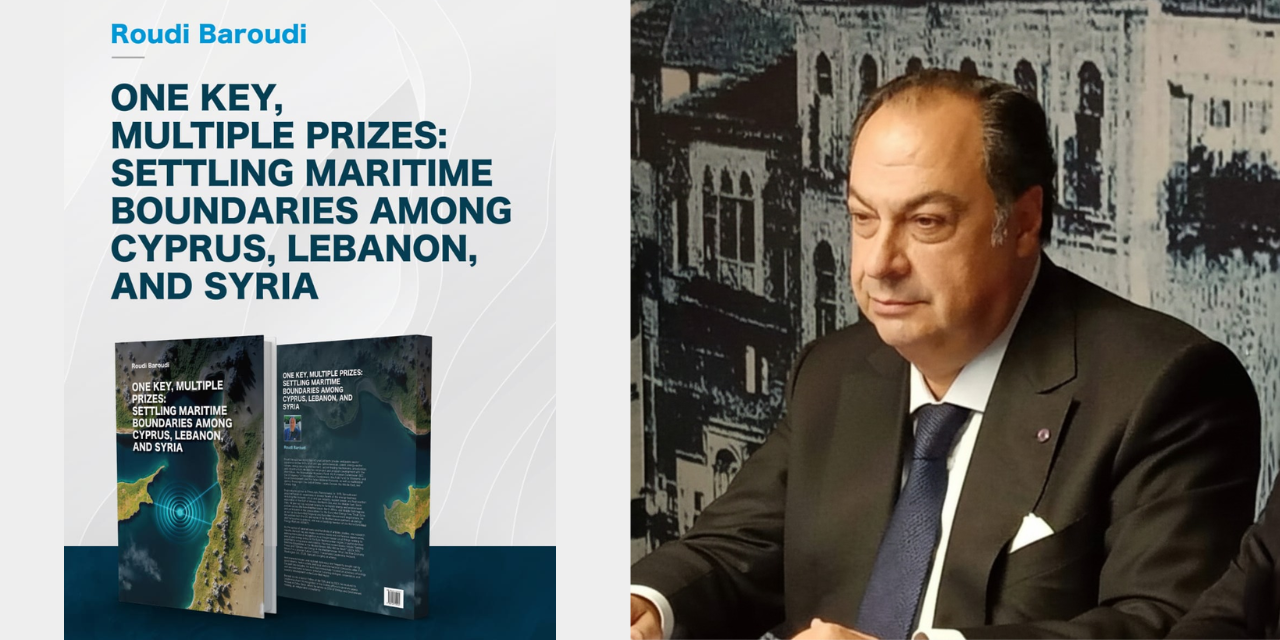
Energy and policy expert Roudi Baroudi’s latest study presaged Lebanon-Cyprus border deal
BEIRUT: Regional energy and policy expert Roudi Baroudi has completed a new study on the benefits of settling maritime boundaries in the Eastern Mediterranean, and the book will be launched at Notre Dame University of Louaize (NDU) just weeks after Lebanon and Cyprus finalized their sea borders.
“One Key, Multiple Prizes: Settling Maritime Boundaries Among Cyprus, Lebanon, and Syria” explains the legal, scientific, and technical standards by which sea borders are determined, providing exclusive maps and specialized analysis of the factors to be considered. The book also highlights the economic opportunities, including offshore energy investment, to be gained by all three countries if and when their maritime zones have been fully demarcated, and is written in a straightforward style designed to be widely accessible.
Baroudi, who has almost five decades of experience in the energy business, has become a high-profile advocate for dialogue, peace,cooperation, and other forms of tension reduction aimed at restoring regional stability and reanimating stalled economies. He met with both Lebanese President Joseph Aoun and Cypriot President Nikos Christodoulides earlier this year, presenting each with an advance copy of the book – even as their respective teams were negotiating the details of the maritime boundary agreement (MBA) they signed in late November.
The signing was a huge step in the right direction,” Baroudi said ahead of the launch ceremony. “Lebanon and Cyprus have sorted out the bilateral details, and now that Syria has a new government seeking to repair its relations with the outside world, it may not be too long before we can settle that border, too.
As the book explains, having settled maritime boundaries is a de facto prerequisite for coastal states seeking international investment in offshore energy exploration and development. Only major oil and gas companies have the financial and technological wherewithal to undertake such projects, and these firms tend to avoid areas with possible border disputes.
Although most of the Mediterranean region’s maritime boundaries remain unsettled, the East Med has made significant progress in recent years, including bilateral deals between Cyprus and Israel, Cyprus and Egypt, and Lebanon and Israel. Now that the Lebanon-Cyprus agreement has been secured, the logical next steps include minor adjustments to the Lebanon-Israel and Israel-Cyprus lines to agree a new trijunction point where the three countries’ maritime zones come together, as well as talks to fix another tripoint for Lebanon, Cyprus, and Syria.
“Once all of these agreements have been signed and ratified, all three countries will be primed for a new era of foreign investment, increased energy security, and maybe even massive energy export revenues,” Baroudi said. “Prosperity is a process, not a promise, so it will take work in other areas as well, especially reforms to guard against waste and embezzlement, but nailing down your maritime zones has to be the first step for any country looking to develop offshore energy.”
Addressing various criticisms of Lebanon’s pact with Cyprus, Baroudi explained that casual observers need to keep a few things in mind.
“There is nothing in this deal that causes trouble between Lebanon and any other country,” he said. “It only clarifies the line between our waters and those of Cyprus. It won’t affect a single offshore block on our southern maritime boundary with Israel, or the northern one with Syria. In fact, it only makes it easier to deal with both of those frontiers.
He acknowledged the “strong possibility that Turkey will be less than thrilled that Cyprus has taken this step, but frostiness in that relationship is certainly nothing new.”
“In fact, the advent of settled boundaries, the prospects of reduced tensions, and the potential for some form of partnership in lucrative exports of offshore oil and gas might well do the opposite,” Baroudi suggested. “Right now an undersea pipeline carrying Cypriot gas to European markets via Turkey sounds like fantasy, but the obvious value such a project would deliver for all concerned makes the idea impossible to ignore. In fact, it adds a considerable financial incentive, for both Cyprus and Turkey, to settle their differences once and for all. Never underestimate the power of enlightened self-interest.”
Baroudi, whose experience includes extensive cross-border energy connection, currently serves as CEO of Energy and Environment Holding, an independent consultancy based in Doha.


