
A Renewed Hope for Lebanon’s Energy Future – A Strategic Opportunity That Must Be Realized and Supported by the Government
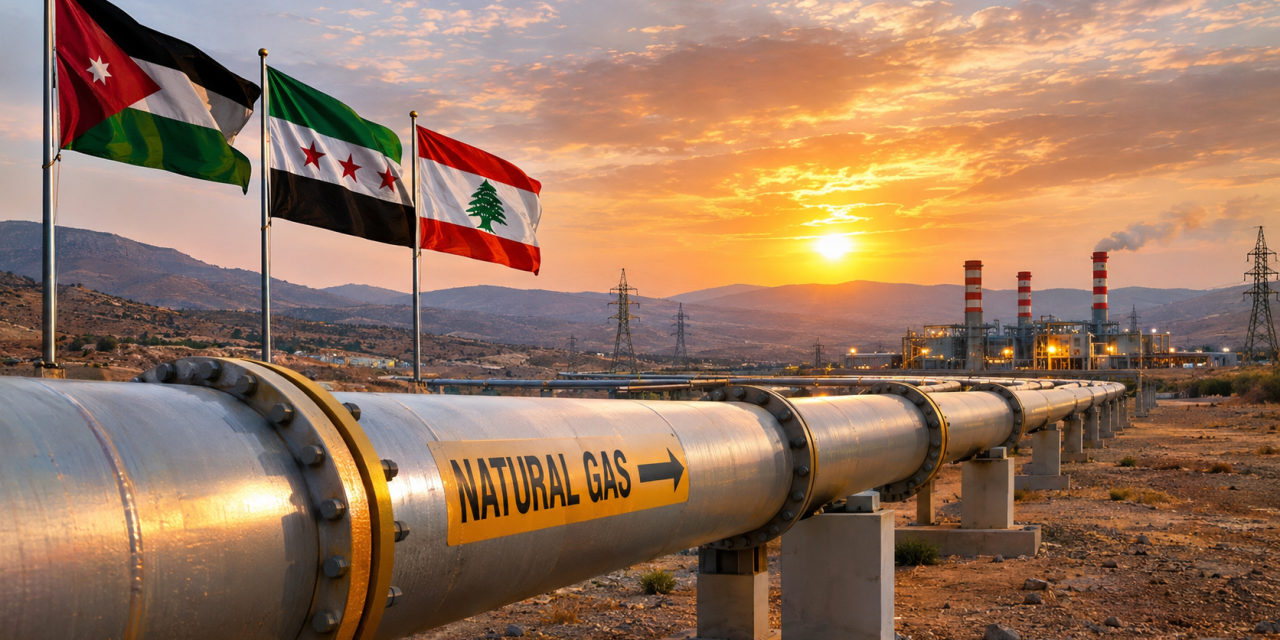
In a development that could revive the long-awaited Arab energy interconnection project, Jordan is aiming to supply Lebanon with approximately two million cubic metres of natural gas per day during the second quarter of 2027, through Syrian territory.
This initiative could represent a significant turning point for Lebanon’s chronic energy crisis, offering an opportunity to restore regional energy cooperation and secure a more sustainable source of fuel for electricity generation.
Jordan Targets Gas Supplies to Lebanon in Q2 2027
Jordanian Minister of Energy and Mineral Resources Saleh Al-Kharabsheh stated in an interview with CNN Business Arabic, on the sidelines of the Jordanian-European Investment Conference, that Jordan is prepared to supply natural gas to Lebanon.
However, the start of deliveries depends on completing maintenance and rehabilitation works on the gas pipelines connecting Syria and Lebanon.
Jordan’s Ministry of Energy has estimated Lebanon’s contractual supply at approximately two million cubic metres per day.
The gas will be imported as liquefied natural gas (LNG) from international markets, converted back into its gaseous form through a floating regasification vessel at the Port of Aqaba, and then transported through the Arab Gas Pipeline.
Economic Benefits for Jordan and Syria
According to Dr. Hashem Akl, an energy and oil expert and Secretary-General of Jordan’s Fuel Station Owners Association, expanding gas transportation to neighbouring countries would allow Jordan to generate additional revenues through regasification, transportation and transit fees.
It would also maximize the use of existing infrastructure, strengthen energy security and attract new investments.
Jordan could potentially become a natural gas producer in the future, particularly if production at the Risha gas field increases.
Syria is already receiving natural gas through Jordan under arrangements that began in January 2026. Although the original agreement provided for four million cubic metres per day, actual deliveries currently stand at approximately 35 million cubic feet per day, equivalent to around one million cubic metres.
According to Syrian Energy Minister Mohammed Al-Bashir, importing gas through Jordan helped increase electricity generation from approximately 2,500 MW to more than 3,000 MW earlier this year.
Syria could also benefit from transit and operational fees, while strengthening its position as a regional energy corridor.
The Jordanian-Syrian Higher Coordination Council discussed two possible options for supplying Lebanon on November 9: transporting natural gas through Syrian territory or using the gas in Syrian power plants and exporting the resulting electricity to Lebanon.
Rehabilitation Costs and Expected Operational Timeline
In Lebanon, data from the Public Procurement Authority revealed that a contract worth approximately $748,100 was signed with TGS in June 2026 to rehabilitate the Lebanese section of the Arab Gas Pipeline, extending from Al-Aboudiyeh to the Deir Ammar power plant.
Lebanese Energy Minister Joseph Saddi announced that rehabilitation of the Lebanese section had been completed, with government funding and Qatari assistance.
Nevertheless, the operational arrangements for restoring the regional energy corridor are still being finalized.
Dr. Hashem Akl emphasized that the Lebanese rehabilitation contract does not represent the total investment required to reactivate the entire corridor. The full costs of repairing the Syrian sections, compression stations and metering facilities have not yet been disclosed.
He added that beginning gas deliveries in the second quarter of 2027 remains a realistic target, provided that pipeline testing in Syria is completed, commercial agreements are finalized and Lebanon’s ability to meet its financial commitments is secured.
The announced date remains a target rather than a guaranteed operational deadline.
A Renewed Hope for Lebanon: From Announcements to Government Action
For Lebanon, this development represents more than a natural gas supply agreement. It is a renewed opportunity to address one of the country’s most persistent economic and infrastructure challenges: the electricity crisis.
The possibility of receiving two million cubic metres of natural gas daily could help reduce dependence on expensive liquid fuels, improve electricity generation efficiency, lower production costs and create more reliable energy supply conditions.
However, this renewed hope must not remain another regional announcement or an unfinished infrastructure project.
The Lebanese government must take the initiative, demonstrate political commitment and provide the necessary institutional, financial and technical support to turn this opportunity into reality.
The priorities should include:
- Finalizing the necessary agreements with Jordan and Syria.
- Securing transparent and financially sustainable gas supply and transit arrangements.
- Completing all technical inspections, pipeline tests and infrastructure rehabilitation.
- Ensuring the readiness of the Deir Ammar power plant and its ability to operate efficiently using natural gas.
- Establishing clear payment guarantees and a sustainable financial framework.
- Developing a long-term national energy strategy that integrates natural gas with renewable energy sources.
Lebanon cannot afford to miss another opportunity to reconnect with regional energy networks.
The Arab Energy Corridor could become a strategic gateway for Lebanon’s energy recovery, regional cooperation and economic development.
The opportunity is there. What Lebanon needs now is a government capable of transforming renewed hope into concrete action, delivering results and securing a more reliable and sustainable energy future for its people.


