As Lebanon continues to struggle with its chronic electricity crisis, international energy expert Dr. Roudi Baroudi recalls that Qatar’s involvement in potential energy solutions dates back more than three decades. From natural gas and electricity generation to renewable energy and oil infrastructure, Lebanon has several promising opportunities that could transform its energy sector, provided the country can secure the political stability, transparency, and institutional commitment required to turn plans into reality.
Lebanon’s energy crisis has once again returned to the forefront of national debate, as the country faces persistent electricity shortages, mounting financial disputes between public institutions, and growing concerns over the sustainability of essential public services.
The latest decision by Électricité du Liban (EDL) to suspend electricity supply to public administrations, institutions, and water authorities that have failed to settle their outstanding payments, effective November 2, with government hospitals exempted, highlights the structural weaknesses affecting the electricity sector.
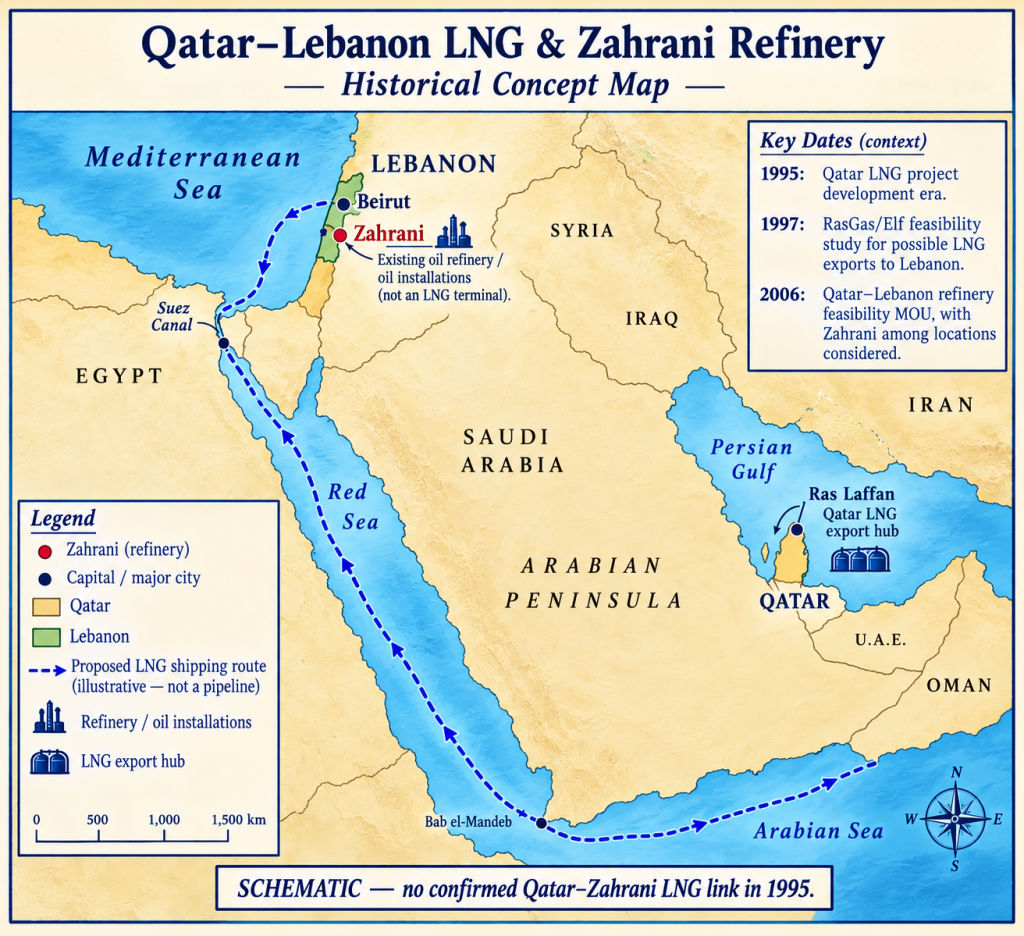
Against this backdrop, Qatar’s renewed interest in supporting Lebanon’s energy sector represents an important strategic opportunity. However, according to international energy expert Dr. Roudi Baroudi, the current initiative is far from new. In fact, one of the most significant proposals for Qatari-Lebanese energy cooperation dates back to 1994, when Qatar explored ways to provide Lebanon with substantial quantities of liquefied natural gas (LNG) at highly competitive prices.
Speaking through LebTalks and BilArabi platforms, Baroudi explained that the original initiative was supported by the then Emir of Qatar, Sheikh Khalifa bin Hamad Al Thani, and envisioned supplying Lebanon with approximately 1.5 million tonnes of LNG annually.
The project was designed around a public-private partnership involving Qatar Petroleum, now known as QatarEnergy, and the construction of an LNG regasification facility at the Zahrani power plant in southern Lebanon.
Importantly, the proposal was not simply a political aspiration. It was supported by a feasibility study financed by a US agency in 1994 and conducted by Kellogg, an international engineering company specializing in industrial facilities and gas infrastructure.
Technical assessments at the time confirmed that the depth and configuration of Zahrani’s port basin could accommodate LNG carriers with capacities of approximately 135,000 tonnes, providing the necessary technical and operational conditions for the project.
The initiative was expected to move into implementation during 1995 or 1996. However, political disagreements and competing interests surrounding Lebanon’s energy sector prevented its realization, resulting in the loss of an opportunity that could have significantly reduced electricity generation costs and improved national supply.
A Renewed Qatari Initiative with Significant Potential
Today, the Qatari initiative is once again being discussed as a potential solution to Lebanon’s electricity challenges.
According to Baroudi, the current proposal involves cooperation with the private sector to secure substantial quantities of natural gas for the Zahrani power plant while doubling its generating capacity.
If implemented successfully, this project could substantially increase electricity availability through the national grid, potentially extending improved supply to large parts of Lebanon.
Baroudi estimates that switching to natural gas and upgrading the facility could reduce electricity generation costs by at least 40%, while also lowering operating expenses and harmful emissions compared with conventional fuel-based generation.
Nevertheless, he stresses that the Qatari initiative is not a “push-button solution.” It is a strategic infrastructure project requiring preparation, financing, technical assessments, institutional coordination, and implementation. A realistic timeframe of approximately two to three years would be required before the project could become operational.
His message is clear: Lebanon must begin the necessary preparations immediately rather than wait for the initiative to materialize on its own.
Immediate Solutions While Preparing Long-Term Projects
While the Zahrani project represents a medium-term opportunity, Baroudi believes that Lebanon should simultaneously pursue practical solutions capable of improving electricity supply in the shorter term.
One such possibility involves utilizing natural gas available through Jordan and transporting it through Syria to Lebanon. This could allow the Deir Ammar power plant in Beddawi, northern Lebanon, to operate on natural gas, with an estimated generating capacity of approximately 450 MW.
Baroudi also referred to reports concerning the possibility of Qatar helping Lebanon secure between 150 and 200 MW of electricity through Syria, using the Ksara interconnection line.
Such an arrangement could provide additional electricity to the national grid, particularly benefiting central Lebanon, while helping address immediate supply shortages.
These options demonstrate the importance of developing a comprehensive energy strategy that combines short-term solutions with larger infrastructure investments.
Renewable Energy: An Additional Strategic Opportunity
Beyond natural gas and conventional electricity generation, Lebanon possesses considerable potential in renewable energy.
Baroudi highlighted the possibilities for Qatari cooperation in solar and wind energy projects, particularly offshore wind development along Lebanon’s northern coastline.
According to his assessment, the northern coastal area could offer offshore wind energy potential of approximately 500 to 700 MW, comparable to the generating capacity of the Zouk power plant.
Developing this resource could diversify Lebanon’s energy mix, reduce dependence on imported fossil fuels, improve long-term energy security, and contribute to environmental sustainability.
Combining natural gas with renewable energy investments would allow Lebanon to adopt a more balanced and economically sustainable electricity generation model.
Reviving Lebanon’s Oil Infrastructure and Refining Potential
Baroudi also recalled earlier Qatari-related proposals involving the rehabilitation and modernization of Lebanon’s petroleum infrastructure.
During the presidency of the late President Elias Hrawi, proposals were examined to develop a new oil refinery with a capacity of up to 100,000 barrels per day, replacing the old Zahrani refinery, which had suffered significant damage.
The proposed rehabilitation programme also included rebuilding approximately 20 storage tanks for petroleum products and related infrastructure.
The estimated investment at the time was approximately $600 million.
These projects were examined during the Hrawi administration and subsequently revisited during the tenure of the late Prime Minister Rafic Hariri, as part of broader efforts to modernize the country’s energy infrastructure and secure domestic market requirements.
Although these plans did not materialize, Baroudi considers them important reminders of Lebanon’s longstanding potential to attract international investment and develop an integrated petroleum and energy industry.
Qatar’s Continuing Engagement in Lebanon’s Energy Sector
Qatar’s involvement in Lebanon’s energy sector has continued beyond the historical LNG initiative.
In 2023, Qatar joined the offshore oil and gas exploration consortium operating in Lebanese waters alongside TotalEnergies and Eni, marking an important step in its participation in Lebanon’s upstream energy activities.
Baroudi also emphasized that Qatar’s relationship with Lebanon extends beyond commercial investments and energy infrastructure, encompassing humanitarian assistance and broader support for the country.
The historical and current initiatives reflect the longstanding potential for cooperation between the two countries and underline the importance of maintaining and strengthening international partnerships.
The Environmental and Economic Case for Natural Gas
The environmental and economic arguments for transitioning towards natural gas were already evident in studies conducted more than three decades ago.
According to the 1994 feasibility study cited by Baroudi, Lebanon’s energy sector was responsible at the time for approximately 85% of the country’s carbon dioxide emissions and 96% of its sulfur dioxide emissions.
The study also identified significant inefficiencies in Lebanon’s energy consumption patterns. Although national energy consumption was lower than that of most industrialized countries, it remained relatively high compared with developing countries facing similar economic and structural conditions.
This pointed to weaknesses in both energy production and final consumption.
Furthermore, the study warned that electricity demand was growing at an annual rate of approximately 3% to 5%, potentially exceeding available generation capacity despite substantial investments in power facilities.
Lebanon’s heavy dependence on imported fuel further increased its vulnerability to international market fluctuations and supply disruptions.
These findings reinforce the importance of adopting more efficient energy sources, improving generation infrastructure, and diversifying the national energy mix.
Lebanon’s Untapped Regional and International Energy Opportunities
Beyond the Qatari initiative, Baroudi has repeatedly emphasized that Lebanon has the potential to benefit from numerous regional and international projects and strategic partnerships capable of providing practical, profitable, and sustainable solutions to its energy challenges.
The country’s geographical position, access to the Eastern Mediterranean, existing infrastructure, offshore energy potential, and proximity to regional gas and electricity networks could create opportunities extending well beyond a single project or bilateral agreement.
Potential areas of cooperation include natural gas imports, electricity interconnections, offshore exploration, renewable energy development, petroleum infrastructure modernization, energy storage, and regional energy transportation networks.
International partnerships could also help attract private investment, introduce advanced technologies, improve operational efficiency, and create new economic opportunities.
However, Baroudi stresses that the availability of investment opportunities, international support, and technical solutions is not sufficient on its own.
Lebanon’s ability to benefit from these opportunities ultimately depends on establishing political stability, demonstrating the capacity to take clear and timely national decisions, ensuring transparency and good governance, and engaging qualified professionals and specialized technical expertise to address the country’s complex political and economic realities.
Without these essential conditions, even the most promising projects risk becoming another chapter in Lebanon’s long history of delayed initiatives and missed opportunities.
From Historical Proposals to Practical Implementation
The recurring challenge facing Lebanon is not necessarily the absence of solutions, investment interest, or international partners. Rather, it is the country’s ability to transform available opportunities into concrete, well-managed, and sustainable projects.
The Qatari LNG initiative of 1994 is a particularly clear example. More than three decades later, Lebanon is still discussing possibilities that could have substantially improved its electricity sector had the original proposal been implemented.
Today, the country has another opportunity to move forward through cooperation with Qatar and other regional and international partners.
For Baroudi, the way forward should involve a coordinated national energy strategy that brings together natural gas, renewable energy, electricity imports, offshore resources, and the modernization of existing infrastructure.
Such an approach would not only help reduce electricity generation costs and improve supply reliability, but could also attract foreign investment, create employment opportunities, strengthen economic competitiveness, and position Lebanon as a more active participant in regional energy cooperation.
Lebanon does not lack potential, nor does it lack possible partners. What it urgently needs is the political will, institutional stability, transparency, and professional execution necessary to turn these opportunities into reality.
The Qatari initiative should therefore be viewed not simply as another proposal to address the electricity crisis, but as part of a much broader opportunity to rethink Lebanon’s energy future.
The real test is no longer whether solutions exist, but whether Lebanon is finally ready to implement them.