
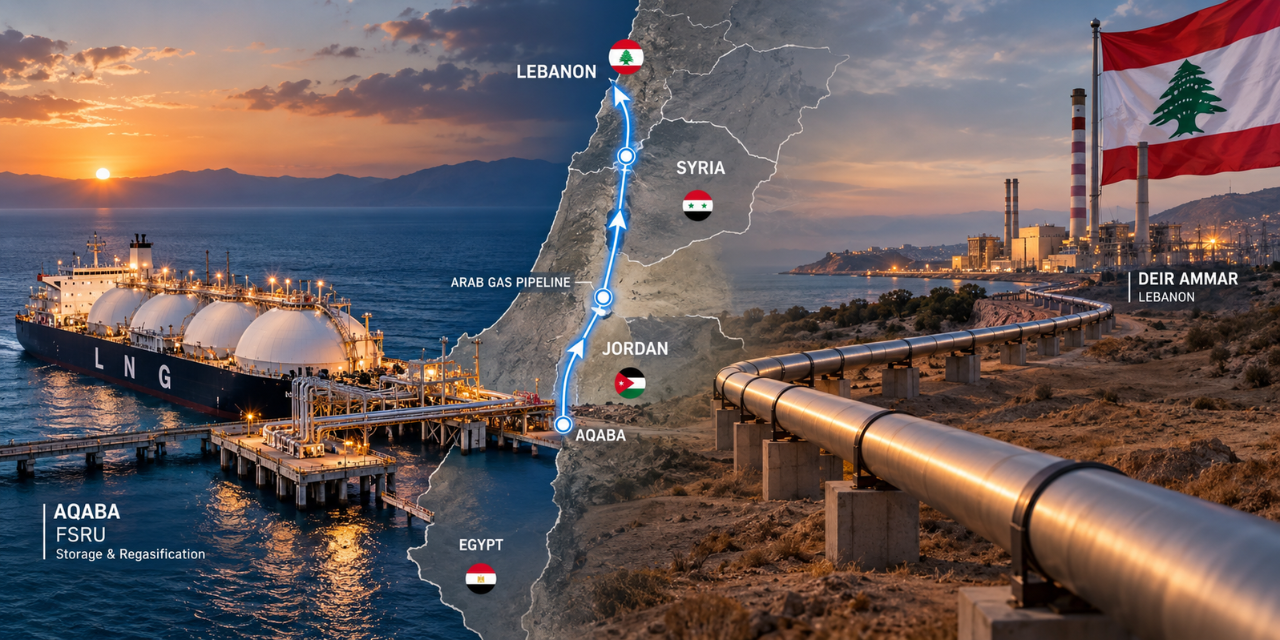
Jordan has agreed to supply Lebanon with natural gas through the floating storage and regasification unit (FSRU) at the Port of Aqaba, with the gas then transported through the Arab Gas Pipeline, passing through Syria before reaching northern Lebanon.
However, the actual source of the gas that will physically reach Lebanon remains unclear.
Jordan imports liquefied natural gas (LNG) through Aqaba while, at the same time, received Israeli natural gas from the Leviathan field. These flows are interconnected within the same gas network. Therefore, knowing the contractual source of the gas purchased by Jordan does not necessarily identify the physical origin of the gas that will ultimately reach Lebanon.
How Will Jordan Supply Lebanon?
Jordan’s Council of Ministers agreed at the beginning of September to supply Lebanon with natural gas through the storage and regasification facility at Aqaba and to transport it through the Arab Gas Pipeline, in cooperation with Syria.
Under the Jordanian plan, LNG is imported through Aqaba, regasified there, and then injected into the Arab Gas Pipeline. From Jordan, the gas network extends northward through Syria and eventually reaches Lebanon.
At the same time, commercial agreements related to the transit of gas between Lebanon, Jordan and Syria are still being finalized in preparation for their approval.
Who Is Currently Using the Aqaba Facility?
The Aqaba storage and regasification facility the Energos Force FSRU leased by Egypt’s EGAS under arrangements involving Jordan’s National Electric Power Company (NEPCO). The facility began operations in August 2025.
The facility has a storage capacity of approximately 3.6 billion cubic feet (BCF) of gas and a regasification capacity of around 750 million cubic feet per day. It is used to strengthen gas supplies to Jordan and Egypt, particularly during periods of peak demand and emergencies.
Since the beginning of 2026, Jordan has been supplying Syria with gas. The quantities delivered at the beginning of the year ranged between 30 million and 90 million cubic feet per day, while the agreement between the two countries provides for the possibility of supplying Syria with up to 4 million cubic metres per day.
According to Jordanian Minister of Energy and Mineral Resources Saleh Kharabsheh, in September 2026 the quantity currently being supplied to Syria stood at approximately 1 million cubic metres per day with work underway to increase it to 2 million to help meet the needs of Syria and Lebanon.
But Which Direction Will the Gas Take?
Gas from the Israeli Leviathan field enters northern Jordan and is connected to the Arab Gas Pipeline network near Al-Rehab. Part of this network is used to transport gas southward toward Aqaba and Egypt.
At the same time, the Aqaba facility receives imported LNG, regasifies it and injects it into the network. In September alone, an LNG shipment arrived at Aqaba to be regasified and then pumped through the Arab Gas Pipeline toward Egypt.
This means that the same pipeline segment cannot necessarily carry the same physical gas molecules north and south simultaneously.
If gas continues to flow southward, sending LNG from Aqaba toward Syria and Lebanon would require either a change in the direction of flow or a redistribution of quantities within the network.
The Possibility of a Gas Swap
This is where the possibility of a gas swap arrangement emerges.
Under such an arrangement, the regasified LNG could be used in Aqaba, Jordan or Egypt, while an equivalent quantity of gas available elsewhere in the network is delivered northward toward Lebanon.
Under this scenario, the gas physically reaching Lebanon could potentially originate from different sources within the interconnected network—including Israeli gas entering the system from the Leviathan field.
What Gas Will Actually Reach Lebanon?
There are three possible operating scenarios:
1/ A Change in the Direction of Flow
The flow within the Jordanian section of the network could be reversed, allowing the regasified LNG intended for Aqaba to move northward toward the Jordanian network and ultimately Syria and Lebanon, in line with Jordan’s official plan.
2/ A Gas Swap Within the Network
Jordan or Egypt could use the LNG currently available from Aqaba, while an equivalent quantity of gas already available within the network is delivered northward.
In this case, the gas reaching Lebanon would not necessarily be the same physical gas that arrived as LNG at Aqaba.
3/ A Swap Involving Syrian Gas
Syria could receive gas supplied from Jordan while, in return, providing Lebanon with an equivalent quantity of gas from its own domestic production.
What Is Still Unknown?
The agreements currently announced do not yet establish which of these mechanisms will actually be used, nor do they identify the physical source of the gas that will ultimately reach Lebanon.
The final cost to Lebanon has also not yet been announced.
That cost is expected to be affected by several components, including:
- The purchase price of the LNG or natural gas
- The cost of transporting the gas
- The cost of regasification at Aqaba
- Transit fees through the Jordanian network
- Transit costs through Syria
- The cost of delivering the gas to Deir Ammar in northern Lebanon
The Key Issue
The central question is therefore not simply where Jordan purchases the gas, but which gas actually moves through the interconnected regional network and reaches Lebanon.
Because LNG imported through Aqaba, Israeli gas from Leviathan, Jordanian gas flows and Syrian supplies may all interact within the same network, the physical origin of the gas delivered to Lebanon may differ from its contractual origin.
Until the final commercial and operational arrangements are disclosed, the exact source, route and final cost of the gas reaching Lebanon remain unresolved.
Source: Sifr Magazine – Marc Ayoub
Article in Arabic


