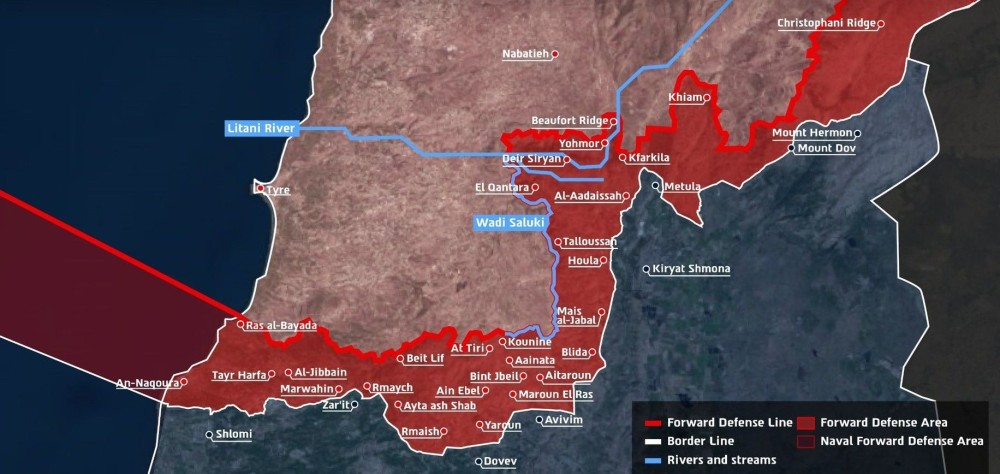
Israel’s newly declared military buffer zone in southern Lebanon is raising serious concerns not only because of its military implications, but also due to its potential impact on Lebanon’s maritime sovereignty, energy resources, and economic future. The newly presented Israeli military map appears to extend beyond land borders into Mediterranean waters, effectively overlapping with the Qana natural gas field — one of Lebanon’s most strategic energy assets, estimated to contain nearly 100 billion cubic meters of natural gas reserves.
The development has triggered fears among political observers and economic experts that Lebanon could face dangerous consequences regarding the previously signed maritime border delimitation agreement between Lebanon and Israel, brokered in 2022 under US mediation. That agreement had been viewed as a historic step capable of protecting Lebanon’s offshore rights and opening the door for economic recovery through future gas exploration and energy investments.
Today, however, major geopolitical transformations in the region, combined with ongoing military escalation and shifting international alliances, may place Lebanon’s maritime gains at risk. Many fear that Israel could exploit the current political and security situation to impose new realities on the ground — and at sea — that could weaken Lebanon’s ability to benefit from the Qana field in the future.
The Qana field was considered one of Lebanon’s most promising economic opportunities, with an estimated value ranging between $20 and $40 billion. Any restriction on access, operational control, or security around the field could severely undermine Lebanon’s capacity to launch energy projects, attract international investment, and rebuild its collapsing economy.
According to the latest Israeli military maps, the newly established buffer zone extends between 5 and 10 kilometers into Lebanese territory. Israel claims the measure is necessary to protect northern settlements from Hezbollah attacks, while Israeli military officials stated that naval forces are also operating simultaneously within the designated zone. Critics argue that the maritime extension of this “yellow line” strategically places the Qana gas field under indirect Israeli operational influence.
This situation has drawn comparisons to previous Israeli actions regarding Palestinian offshore gas reserves near Gaza. Since imposing its blockade on Gaza in 2007, Israel has effectively controlled access to Palestinian maritime resources, while international energy companies increasingly bypassed Palestinian authorities in favor of agreements with Israel concerning exploration and development rights.
Meanwhile, destruction across southern Lebanon continues to intensify. Reports from Lebanese research institutions indicate widespread demolition of homes and infrastructure in border villages, with some communities reportedly wiped off the map. Israeli officials have openly referenced applying the “Gaza model” in southern Lebanon, further deepening concerns about long-term territorial, demographic, and economic consequences.
Despite ceasefire arrangements, Israeli military warnings to residents of southern Lebanon continue, with restrictions imposed on movement near the designated line. Lebanese civilians remain unable to safely return to several border villages due to ongoing military tensions and security risks.
In light of these developments, Lebanon’s government and political leadership face a critical national responsibility. Lebanese officials, ministers, and decision-makers must fully recognize the scale of the geopolitical changes taking place across the region and respond with strategic intelligence, diplomatic unity, and economic foresight. The protection of Lebanon’s maritime rights, offshore energy wealth, and national sovereignty can no longer be treated as secondary issues.
Lebanon urgently needs a coherent national strategy capable of safeguarding the country’s interests before regional power shifts create irreversible realities that could ultimately deprive Lebanon of its legitimate natural resources and economic future. Without proactive diplomatic action, international engagement, and internal political coordination, Lebanon risks losing one of its final opportunities for economic recovery amid an increasingly unstable regional landscape.