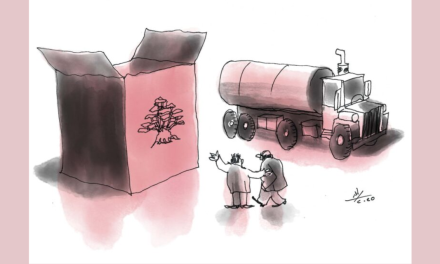
The Eastern Mediterranean has emerged as one of the most strategically important energy frontiers in the world. Natural gas discoveries offshore Israel, Cyprus, and Egypt have reshaped regional alliances, export strategies, and geopolitical calculations. At the heart of this transformation stands Chevron Corporation, backed by a clear and assertive U.S. policy to lead and structure the energy potential of the Levant basin.
From Cyprus to Israel, Egypt, and now Syria, the United States is not merely investing in gas exploration—it is positioning itself to shape the long-term energy architecture of the region. Yet amid this accelerating regional integration, Lebanon remains outside the emerging American-led energy map.
Chevron’s Expanding Footprint in the Levant
Chevron has steadily built a substantial gas-focused portfolio in the Eastern Mediterranean. During its latest earnings discussions, the company’s leadership emphasized strong optimism about the region’s resource potential and confirmed ambitions to increase output by 25% before the end of the decade.
Today, Chevron plays a key role in:
-
- Israel’s offshore production,
- Cyprus’ development projects,
- Egypt’s established gas infrastructure,
- Partnering with HELLENiQ Energy in Greece and Turkish Petroleum Corp (TPAO) in Turkey.
- And, more recently, Syria through a memorandum of understanding signed with the Syrian Petroleum Company and Qatar’s Power International Holding.
This expansion reflects more than commercial interest. It aligns with broader U.S. strategic objectives aimed at influencing gas flows toward Europe, strengthening regional partnerships, and limiting the space for rival global players. Energy policy here is inseparable from geopolitics.
Syria’s Entry and the Implications for Lebanon
Syria’s agreement with Chevron marks a significant shift. Exploration studies are expected to begin shortly, with the possibility of full implementation if economic viability is confirmed. The move positions Syria as an emerging player seeking to capitalize on improved political alignments and external partnerships.
For Lebanon, however, this development introduces urgency and concern. The northern maritime boundary between Lebanon and Syria remains undelimited. An estimated 750–1000 square kilometers of maritime area may overlap, particularly near Lebanese Blocks 1 and 2. Without a finalized border agreement, the presence of a major U.S. operator in adjacent waters increases legal and diplomatic pressure.
Chevron’s growing presence across the Levant effectively surrounds Lebanon within an expanding U.S.-aligned energy corridor.
Lebanon’s Energy Sector: Potential Constrained by Politics
Lebanon has made efforts to position itself as a future energy producer. Exploration activities led by TotalEnergies, Eni, and QatarEnergy have demonstrated technical engagement. However, earlier drilling results in Blocks 4 and 9 did not confirm commercially viable gas quantities, dampening investor enthusiasm.
Yet geology alone does not explain Lebanon’s absence from Chevron’s map.
Several structural factors continue to limit international engagement:
1. Administrative and Regulatory Reform
International energy companies require stable legal frameworks, transparent bidding processes, and predictable fiscal regimes. Lebanon’s reform trajectory remains incomplete and inconsistent.
2. External Political Stability
Unresolved border issues with Syria and ongoing sensitivities regarding maritime boundaries with Israel add layers of geopolitical uncertainty.
3. Internal Sovereignty and Security Consolidation
A central condition for major strategic investment is the clear authority of the state over all its territory. The ability of the Lebanese Armed Forces to establish comprehensive control across all Lebanese lands—particularly upon the conclusion of the weapons confinement process—remains a key signal for international stakeholders evaluating long-term risk.
In energy geopolitics, perception of stability is as crucial as resource availability.
A Strategic Imbalance
The United States does not depend on Lebanese gas to secure its energy objectives. Its engagement in the Eastern Mediterranean is driven by strategic positioning rather than necessity. By accelerating projects in Israel, Cyprus, Egypt, and Syria, Washington is consolidating influence across the region.
Lebanon, by contrast, needs international backing—especially American political and economic engagement—to unlock its offshore potential and integrate into regional energy networks.
Each new regional agreement reduces the urgency for global players to wait for Lebanon. Energy corridors form around stable anchors, and today those anchors lie outside Lebanese waters.
The Path Forward for Lebanon
Lebanon still holds ten offshore blocks and retains untapped potential. To reposition itself within the regional energy framework, it would need to:
-
- Accelerate maritime boundary negotiations with Syria,
- Implement comprehensive administrative and regulatory reforms,
- Strengthen institutional transparency in the energy sector,
- Demonstrate credible and measurable security consolidation under full state authority,
- Encourage diversified international participation beyond a single consortium model.
The presence of a major American operator such as Chevron would not replace existing partners but could complement and diversify Lebanon’s energy ecosystem, increasing competition and investor confidence.
Conclusion: A Region Moving Forward
The Eastern Mediterranean energy map is being actively drawn. Chevron, aligned with U.S. strategic direction, is shaping a new regional gas order stretching from Cyprus to Israel, Egypt, and Syria. Infrastructure, exploration, and political alignments are advancing simultaneously.
Lebanon’s challenge is not the absence of potential resources—but the absence of the political, administrative, and security conditions required to attract decisive strategic investment.
The regional energy race is accelerating. Whether Lebanon joins the emerging Levant energy corridor—or remains a bystander—will depend on the speed and seriousness of its internal reforms and its ability to ensure full political and territorial stability.